
Why Do We Identify With Violence Dads?
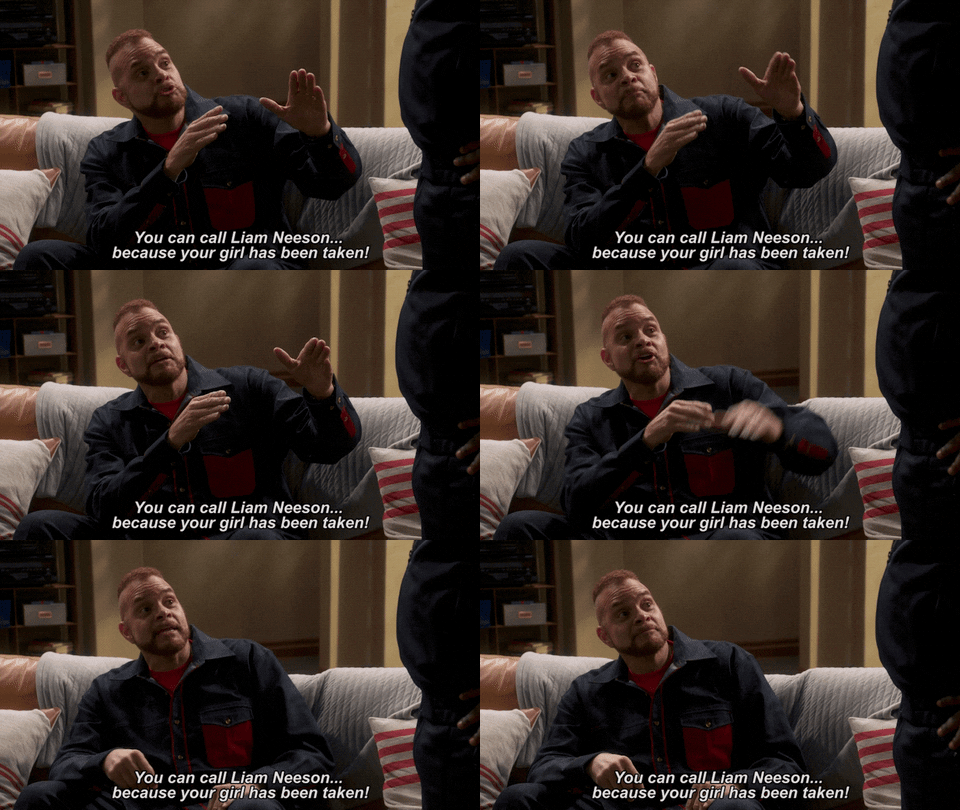
If Tom Hanks is America’s Dad, then Pedro Pascal has become America’s Violence Dad! Sorry Liam Neeson, but your throne as such has been… taken!

Tonight on HBO, the finale airs of this month’s hot zombie show… The Last Of Us! As I’ve alluded to in previous posts, I’m pretty interested in this show, what it represents and what is it about Pedro Pascal that has made him so suitable to portray not one, but two of the most definitive characters in recent TV (shout out to The Mandalorian, with its new season airing on Disney Plus) both of whom fall into the archetypal bucket of…
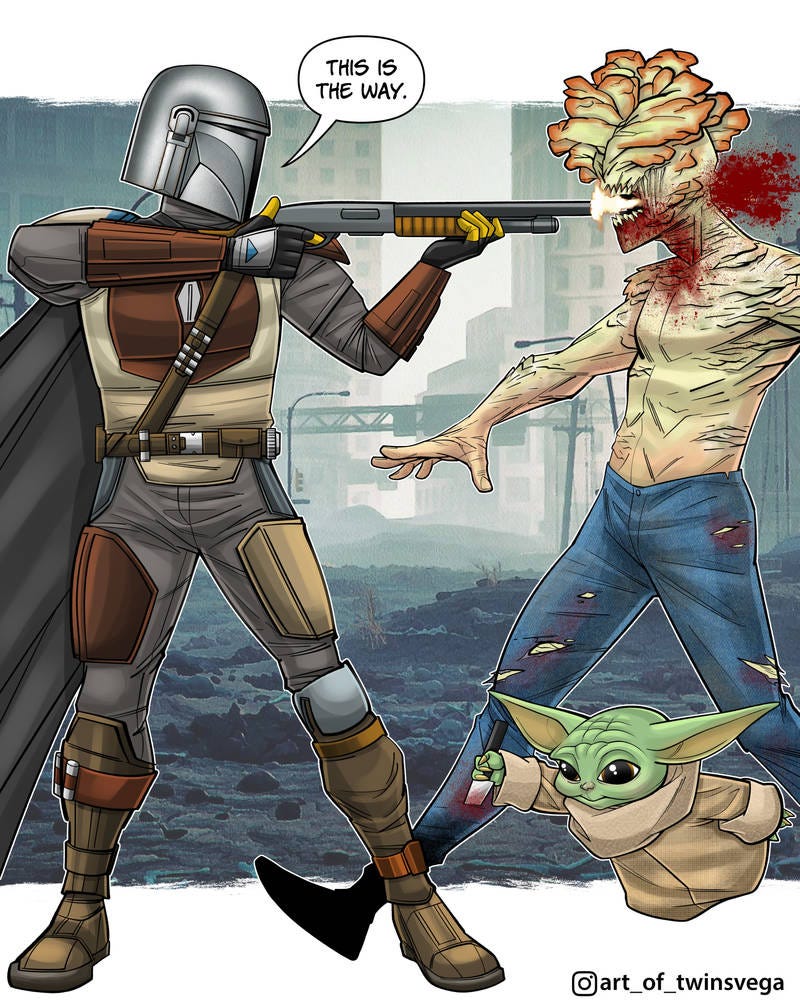
The Violence Dad! Yes, if the aughts gave us Manic Pixie Dream Girls, so far the late teens and early twenties have given us The Violence Dad. Although actually the trope can recently be traced to 2008’s Taken, and Cormac McCarthy’s 2006 novel The Road is an important contributor to the genre, but just go with me that this has come into its own in the 2010s. And continued to flourish into the culture of the 2020s, and…um…
OK so maybe Violence Dads have more staying power than the Manic Pixie Dream Girl. To be fair, the MPDG is kind of a modern idea, whereas Dads have been using violence to various ends since the origination of culture! Or at least in a lot of the foundational myths of the western consciousness.
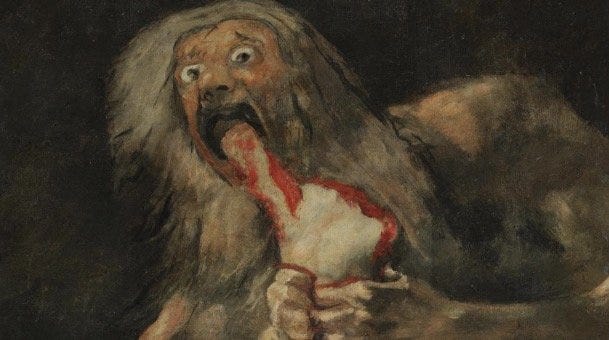
Saturn eating his children is one Violent Daddy!
As there are plenty of stories where a paternal figure goes on… to kill.
Or be killed! Like in the Oedipus and Electra stories, you kill daddy!
Sidenote: I think The Odyssey is fascinating because it ends with Athena coming down and instructing Odyssesus, very directly, to NOT CHOOSE violence when it comes to killing all the male relatives of his wife’s dead suitors, which he and Telemachus are totally ready to do at the end of the story.
But I think the modern foundational work that explores a Dad who uses violence goes back to the seminal 1970 samurai manga Lone Wolf and Cub, spawning a successful film series starting with 1972’s Lone Wolf and Cub: Sword of Vengeance, currently streaming in the US on HBO Max (along with its five sequels).
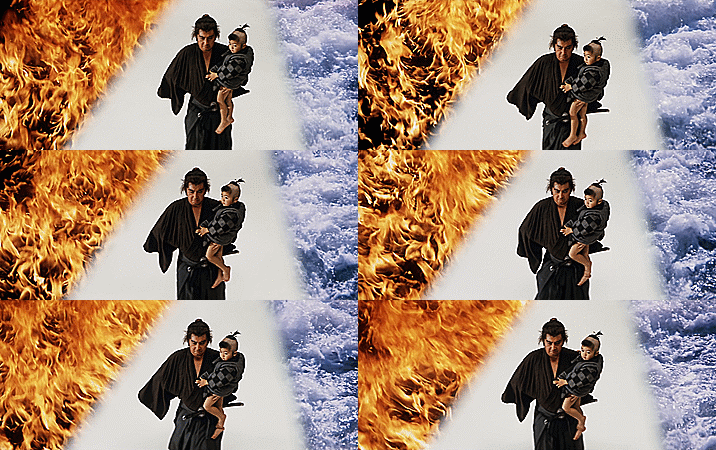
This movie is amazing and you should check it out.
To give a brief summary, it’s a samurai story where the betrayed state executioner of the shogunate must turn ronin assassin to get vengeance on the clan who killed his family… while simultaneously protecting and raising his infant son. It is also extremely violent and merits all the trigger warnings imaginable, but if Quintin Tarantino is your guy, definitely check it out for the Kill Bill influence (and full on name drop in Kill Bill Vol 2 when the little girl wants to watch Shogun Assassin, an American recutting/dub of the first two movies).
Here is a male character (our Jungian warrior archetype) driven by his most toxic traits (violence, the need for vengeance), but they’re subservient to the need to protect (and raise) one most vulnerable and intimately connected to his being, his child.
In the case of Lone Wolf and Cub, all of this is tied into duty and honor and his deliberate subjugation of his own humanity. That his own honor has been so thoroughly destroyed that the only way to redeem it is to destroy the good parts in himself and walk the (melodramatically but delightfully named) DEMON PATH, where he must take his infant son with him as they’re both tied up in the business of clan based vengeance, because this is Japan in the 1800s but filmed in the 70s. Operatic in it’s themes but also gonzo and over the top with the sex and violence. Did I mention I really like these movies? I’ve seen the first two so far and they are *chef’s kiss* if that sounds like your cup of tea.
Lone Wolf and Cub (the manga) was a response to the violent turmoil of Japan (and indeed, the world) in the 1960s. In 1970, violence had left it’s scar on Japanese society, from its participation in World War II, as a western imperial vassal state of empire in Vietnam, and domestically, just a lot of violent events, including one prominent Japanese right wing radical committing literal seppuku, that rocked the country and violent protests similar to what was happening in the rest of the world. It was a mess.
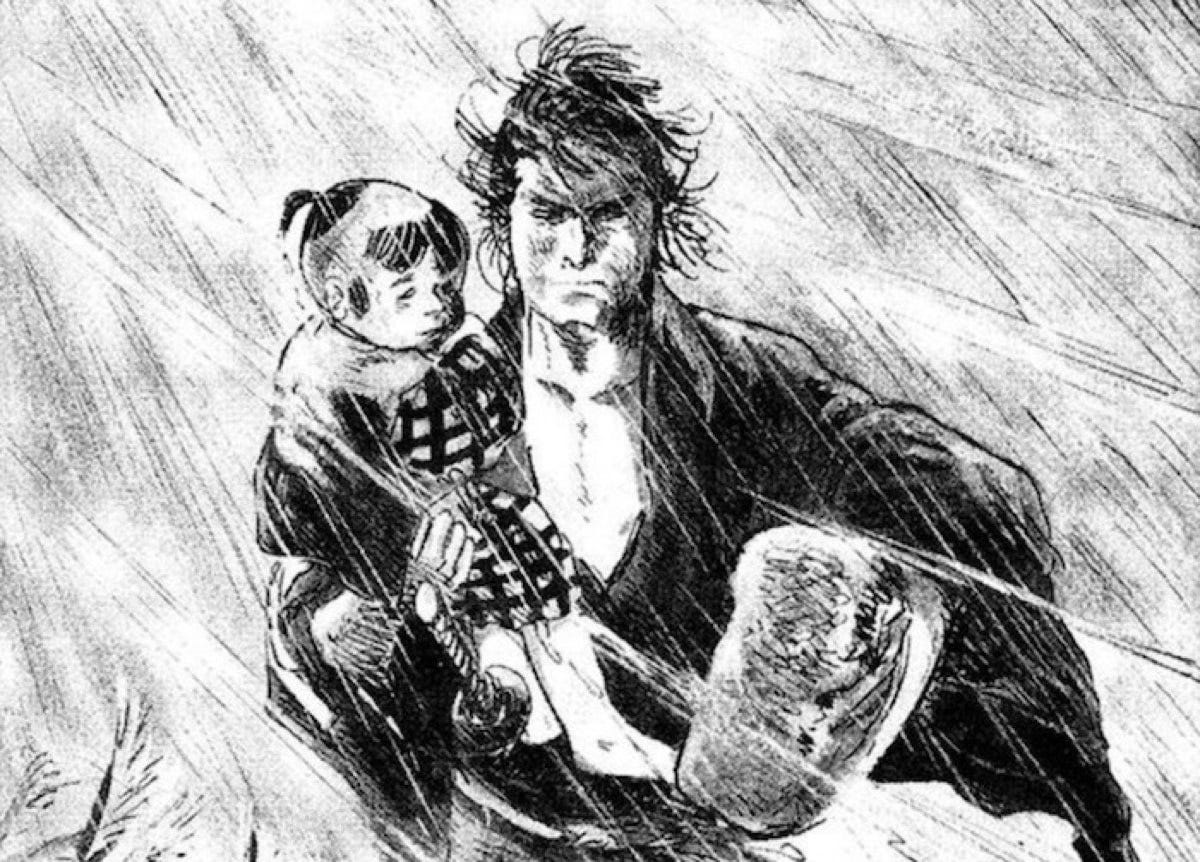
I haven’t read the manga, but it’s supposed to be very good as well.
And I guess something about the father and son dynamic spoke to a society that found itself in the throes of violence, and wanted to feel protected while reckoning through pulp media with the violence around them. And the confucian dynamic of father and son is very powerful and spoke to the Japanese collective psyche. Or so goes my own bullshit theorizing! Look at this guy (me) Mr. Arm Chair sociologist over here!
We see a parallel to this air of violence after 9/11. This made fertile ground for a story to take off like Luc Besson’s Taken. And while I don’t claim that the movie is high art, Besson is good at what he does, and Liam Neeson was surprisingly effective as a subdued Dad type who turned out to be a trained killer, ready to take whatever violent action was necessary to save his daughter from anonymous Eastern European goons. Oh and that one moment with the special set of skills speech? Fucking awesome.
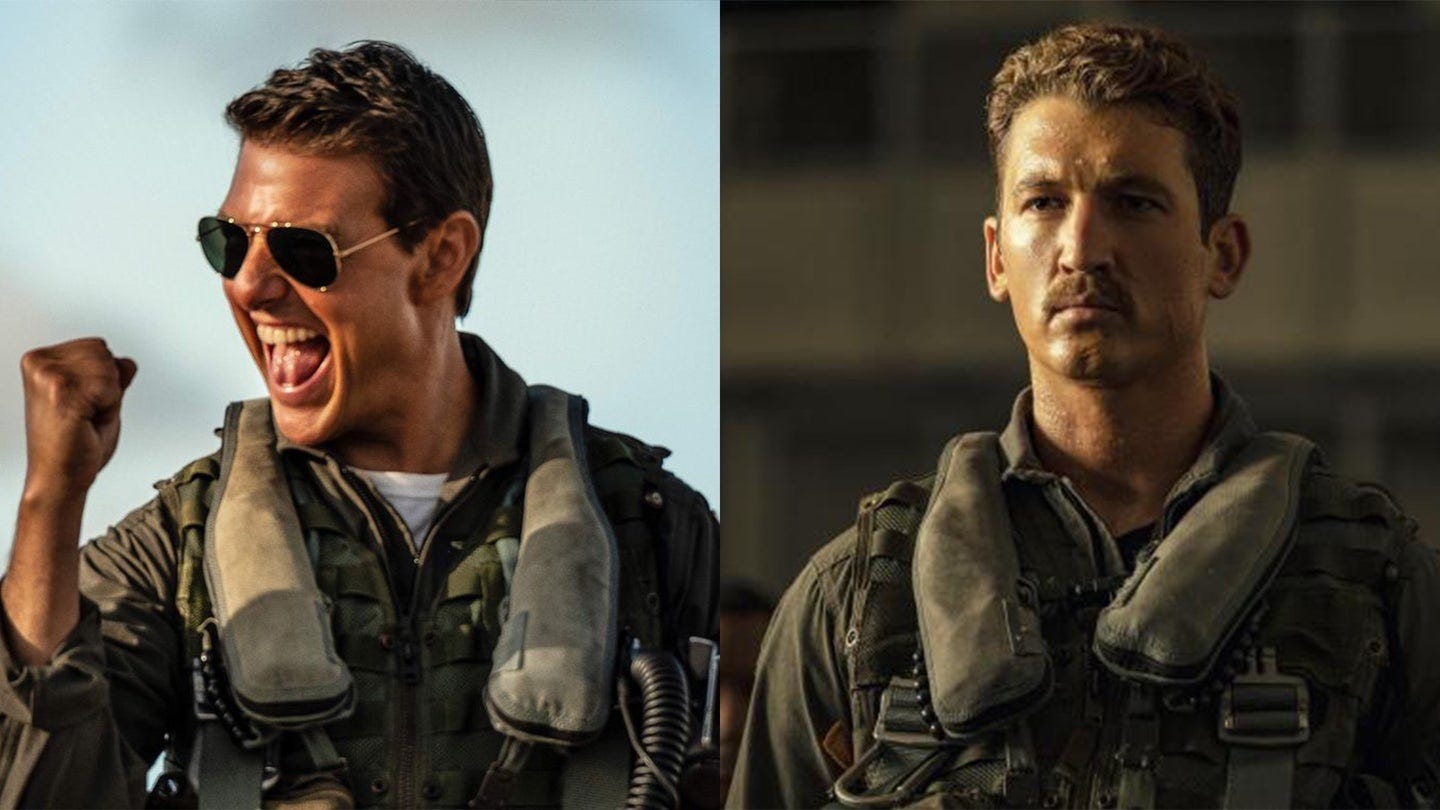
In the recent meta post-post modern takes on the trope, vengeance or “saving the princess” or whatever is no longer the motivation. The prevailing thematic motivation as I see it, is REDEMPTION. And it’s not his child, but his BEST FRIEND’S who died in his arms (Top Gun: Maverick) (Tom Cruise is the father figure, Miles Teller the son of his dead friend who he must protect and redeem himself towards).
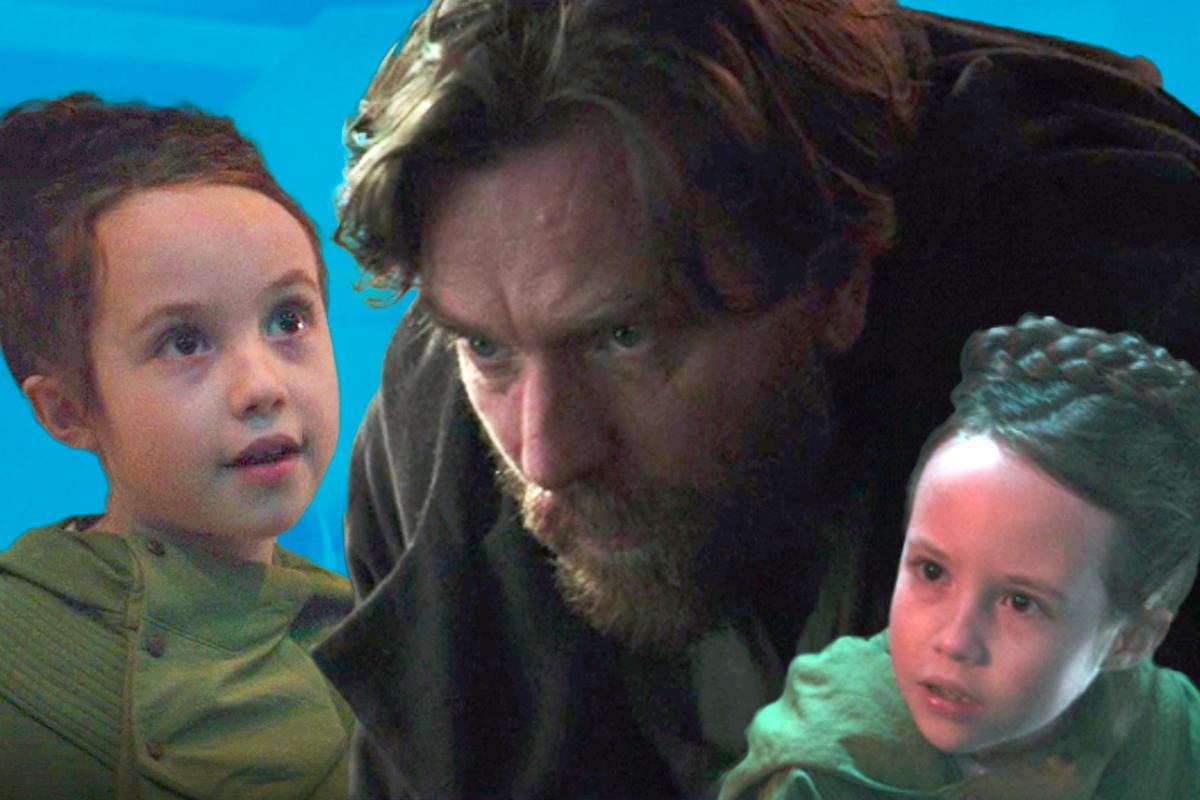
Or, the child of his best friend and mentee, who turned evil and he had to dismember on a lava planet, but not before the best friend killed his wife and the mother of BEST FRIEND’s child and now you have to protect her and keep the secret of her identity and- Oh Obi Wan. It was such a fun idea to pair up Ewan Mcgregor’s older Obi Wan with Lil Princess Leia, but they could just not make it work under the auspices of Disney’s demands for… I don’t even know what, but that’s a whole other piece.
But in The Mandalorian the child is a fellow orphan of war, and in The Last Of Us, a fellow victim of world wide trauma. (Gosh is there a world wide trauma that this story could be reflecting? Oh yeah, Covid 19. And I would argue The Mandalorian is a reflection of the middle eastern refugee crisis of the 2010s, but that’s just me).
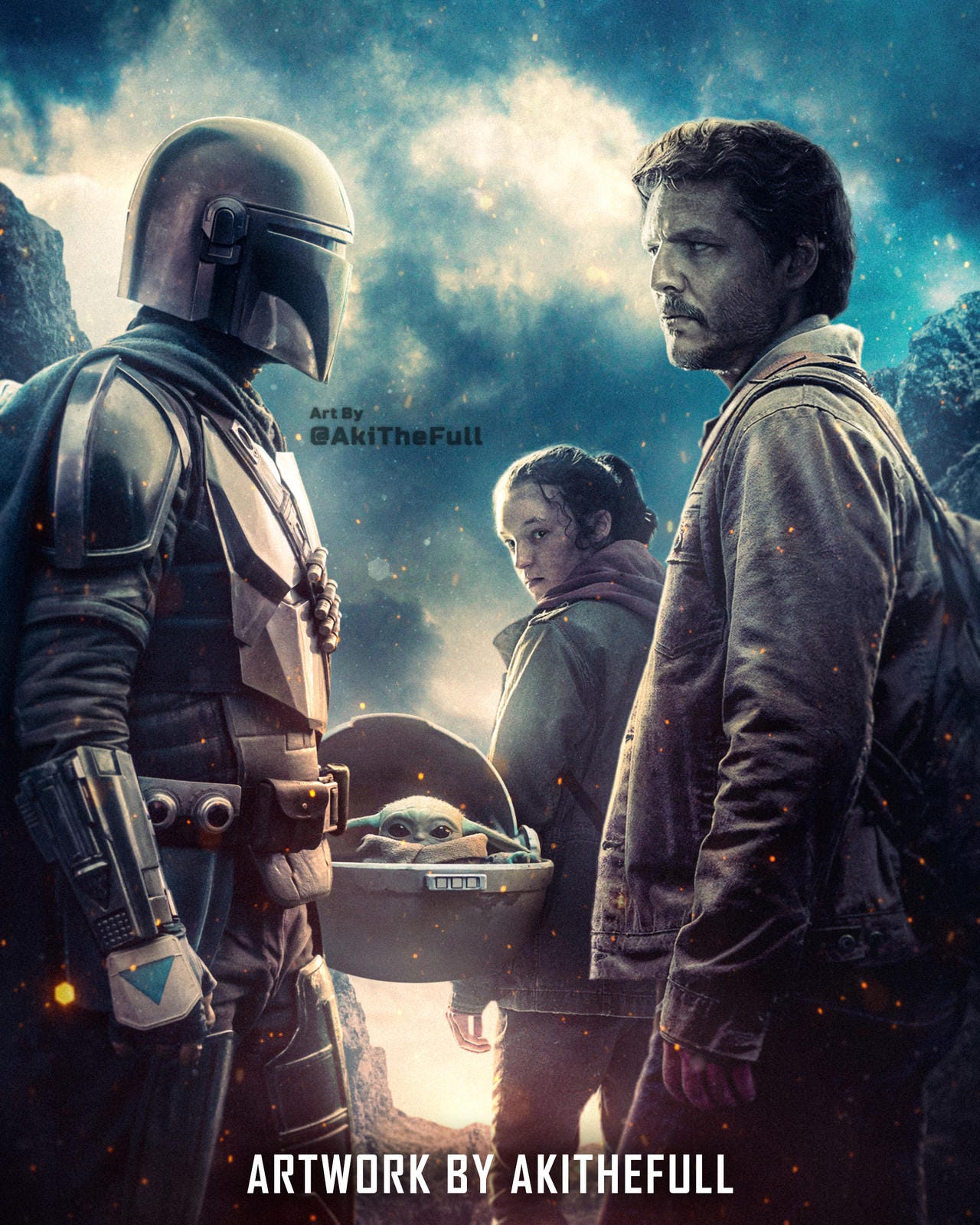
Which brings us to Pedro Pascal. If Tom Hanks is America’s Dad, than with his dual roles as Din Djaran in the Mandalorian and Joel in The Last Us, then Pedro Pascal is America’s violence dad! Sorry Liam Neeson, but your throne has been taken! See what I did there?
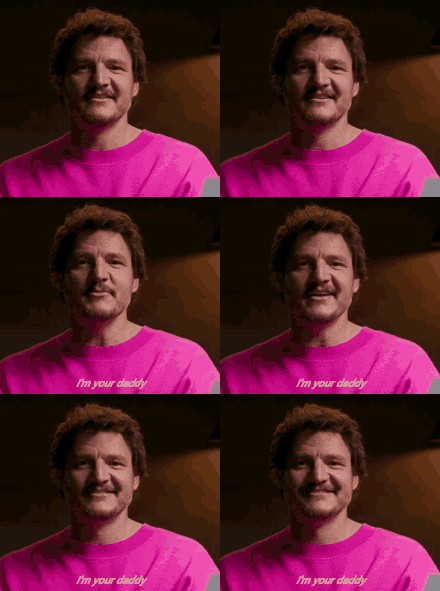
If you’d told me that the guy who stole America’s hearts getting his eyes caved in by The Mountain on Game Of Thrones, and went on to star in what’s probably the best overall season of Netflix’s Narcos (season 3 of the original series, when Boyd Holbrook’s stupid white guy leaves the narrative) would become America’s Violence Dad after a global pandemic sent everyone seeking feel good darkness and violence… then I would ask what are you doing in my living room? And then I’d be like, I guess I can see that, Pedro Pascal is a really good actor!
Pedro Pascal has a unique ability to portray a certain weary but sensitive masculinity and a patriarchal devotion to a world view that both enhances and undermines his Dad-bilities as Joel and Din Djarin respectively. In season one of The Mandalorian, he’s driven by one creed and honor bound set of laws to turn Baby Yoda over to Werner Herzog and his evil scientist dudes. Like, that’s what they paid him for! In Bheskar, his people’s most sacred armor building substance! (Side note, kind of interesting how Mandalorians are like these weird Space Dwarf-Elf Hybids now) (another side note, the more time I spend watching The Mandalorian, the less I care about world building and just want fun hijinks and Baby Yoda reactions).
At the same time, he sees in Baby Yoda a fellow foundling (which is like, a thing with his weird death cult), an orphan of war who still managed to save his ass from Space Rhino back on… whatever planet that was. Let me take that again, back on that generic volume set in Episode 2, but it’s still just so cute seeing Baby Yoda use his widdle force powers that you just temporarily forgive the show for all its flaws.
If you’re unfamiliar, “shooting on volume” is a technique that Disney especially is using on these Star Wars shows, where basically have actors acting against a giant LCD screen that projects the environment. Last of Us also uses this trick a lot, and both shows are case studies in it’s use and development in prestige television, if nerdy shit like that interests you.
Speaking of nerdy production shit, it's also worth noting Pedro Pascal’s Mandalorian isn’t just Pedro Pascal! It’s Pedro and a crew of stunt performers wearing the suit in any given shot. To their credit, Mando has a particular way of moving through the world that communicates even though he’s trapped behind a helmet as part of his adoptive war cult, he has feelings too!
It’s easy to forget, but when The Mandalorian first came out, Baby Yoda was a crazy insane revelation! From the first moment of the story, we establish that this guy’s whole modus operandi is violence. At the episodes midpoint, we learn about his backstory as a foundling, orphaned by the civil war.
But then in the final moment when he finds Baby Yoda, kills the knock off IG88 voiced by Taika Waiti (all of which is perfect, by the way)... and extends his finger, and Baby Yoda reaches for it? That right there is the best thing Disney’s Star Wars has done up to this point, full stop, hands down.
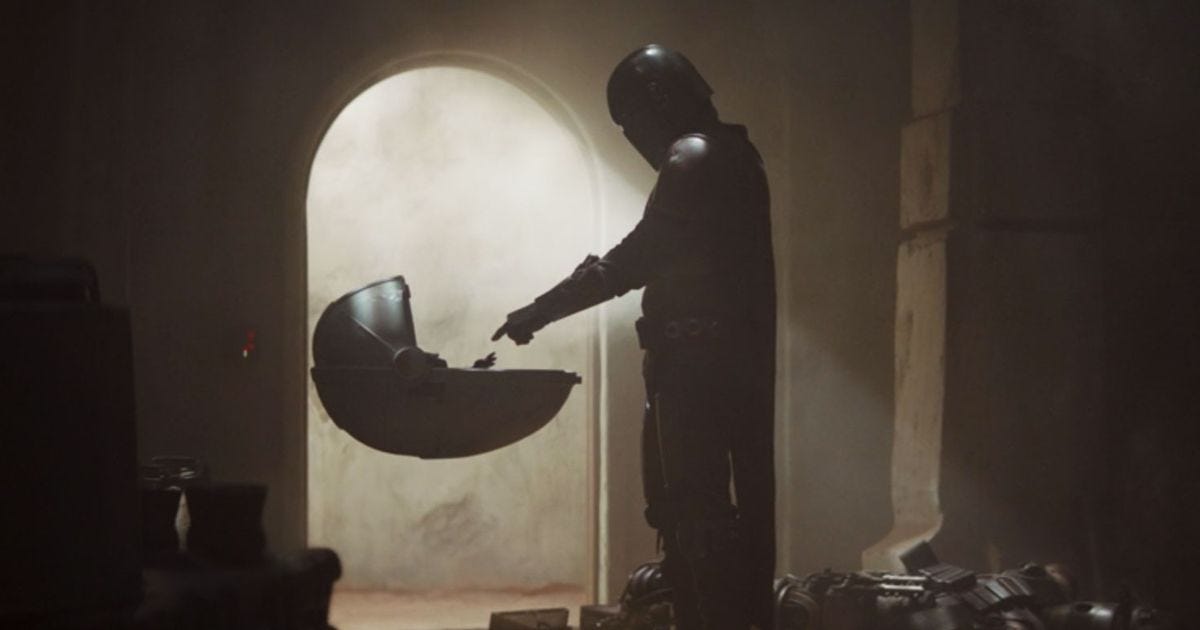
When this happened it was like ohhhhhh shit…
And it’s a total left turn into a story no one saw coming, but also spoke perfectly to a pandemic traumatized audience who just wanted to lose their minds over something as ABSOFREAKING ADORABLE as Little Baby Yoda. Or… Grogu, I guess, but I prefer Baby Yoda.
In the recent episodes, there were some weird shenanigans to get Baby Yoda back with Mando after they… kinda put a bow on the story in season two with Uncle Luke taking Grogu to be a Jedi… OK sidenote but the scene where Grogu chooses between Yoda’s Lightsaber and the Widdle Baby Chainmail is lifted DIRECTLY from Lone Wolf and Cub and is the best thing about Book of Boba Fett, but I digress.
Indeed, what’s especially heart warming and actually kind of makes it work (at least for The Mandalorian, Boba Fest sucked a lot) is that now, these characters have made each other their CHOSEN families. Mando chose Baby Yoda over the part of his creed that said to be a good bounty hunter. Baby Yoda chose Mando, because he loves him, the Jedi kinda suck, and based on the events of the new trilogy, he did the right thing! Or actually, did he? This is way off topic, but if Baby Yoda had stuck around when Ben Solo/Kylo Ren/Adam Driver came to be trained in the force, could he had prevented all that awfulness through the sheer power of his good vibes? We’ll never know.
Anyway, for season 3 our chosen family is reunited and the narrative is all about redemption! Apparently! As of writing we’re only three episodes in, but we’re here today because we’re pumped about the season finale of The Last Of Us, am I right? And that show is all about a narrative of redemption for Joel. Where he tosses off his creed of not helping people, and learns to love a surrogate daughter figure.
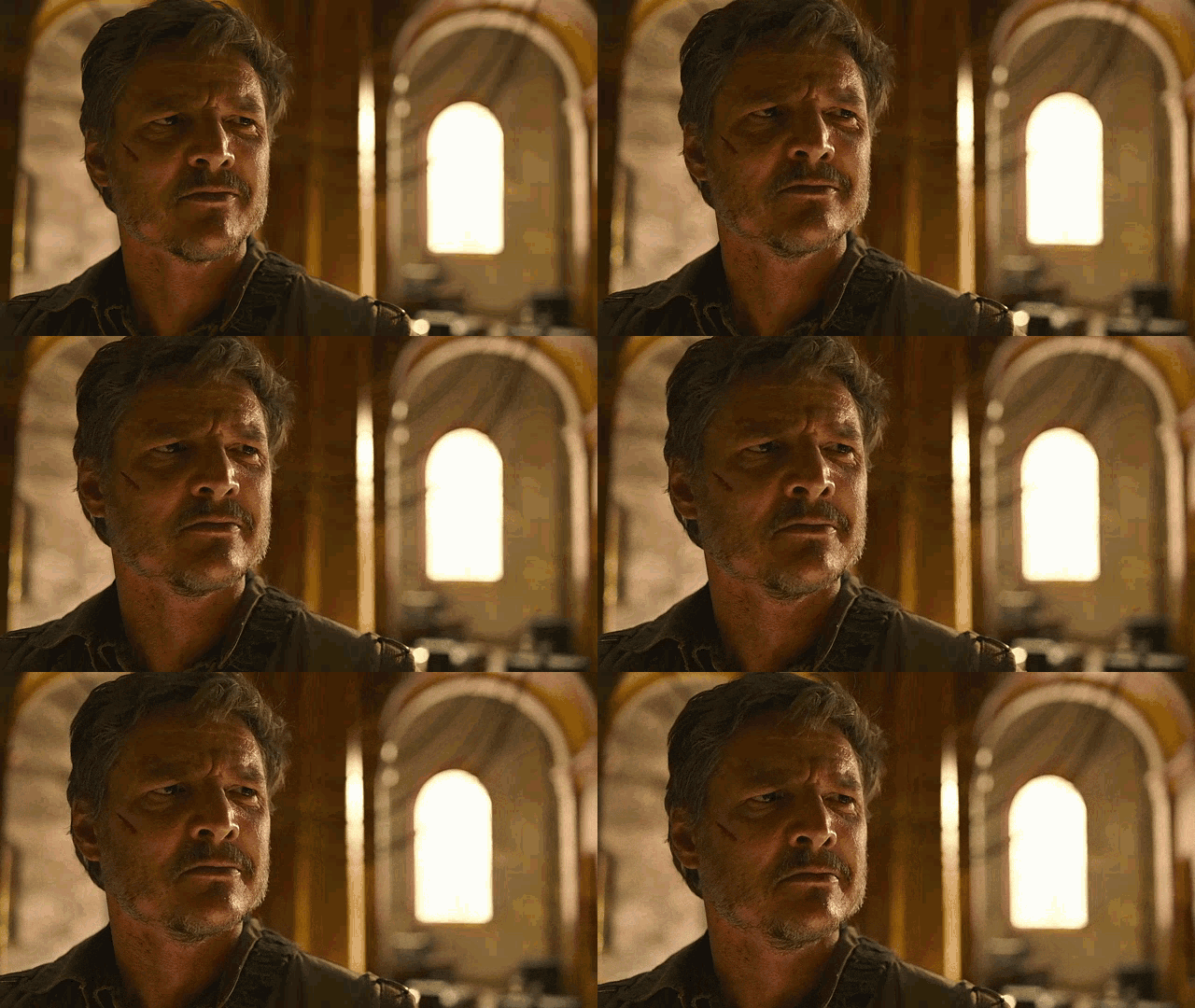
I especially appreciated how Episode 8 (the one with the you-know-what) brought home this theme of “who’s your daddy, and how/why does he use violence to protect you?” very explicity! It was very gratifying as I was working through this text to hear it articulated like that. But let’s focus on how the themes are established in the pilot, in anticipation of whatever’s going to happen tonight. Hopefully some threads are tied up, but I’m sure they’ll be extending like a fungal infection into next season’s profits! Hey Oh!
When the Last Of Us pilot gets going after the cold open, we see Joel’s daughter is more taking care of him than she is of her. And the theme of the show is immediately stated by his daughter (see how its the side characters pointing out the main theme to the protagonist?), “He loves you”, “he’s dependent on me”, “I think it’s the same”.
Shortly after, we get another significant image, the daughter with the knife. She talks to their neighbors (can you trust your neighbors, another significant theme!). And right about then, we’ve all been waiting for it, that’s right… the apocalypse happens.
And at the end of Act One, as much as he loves her, Joel can’t protect his daughter from the violence and chaos of the world! When his daughter is killed, his core wound is established. He’ll need to REDEEM himself to himself for his fundamental failure (and also for all the terrible stuff he’ll do in the post apocalypse but he’ll get there).
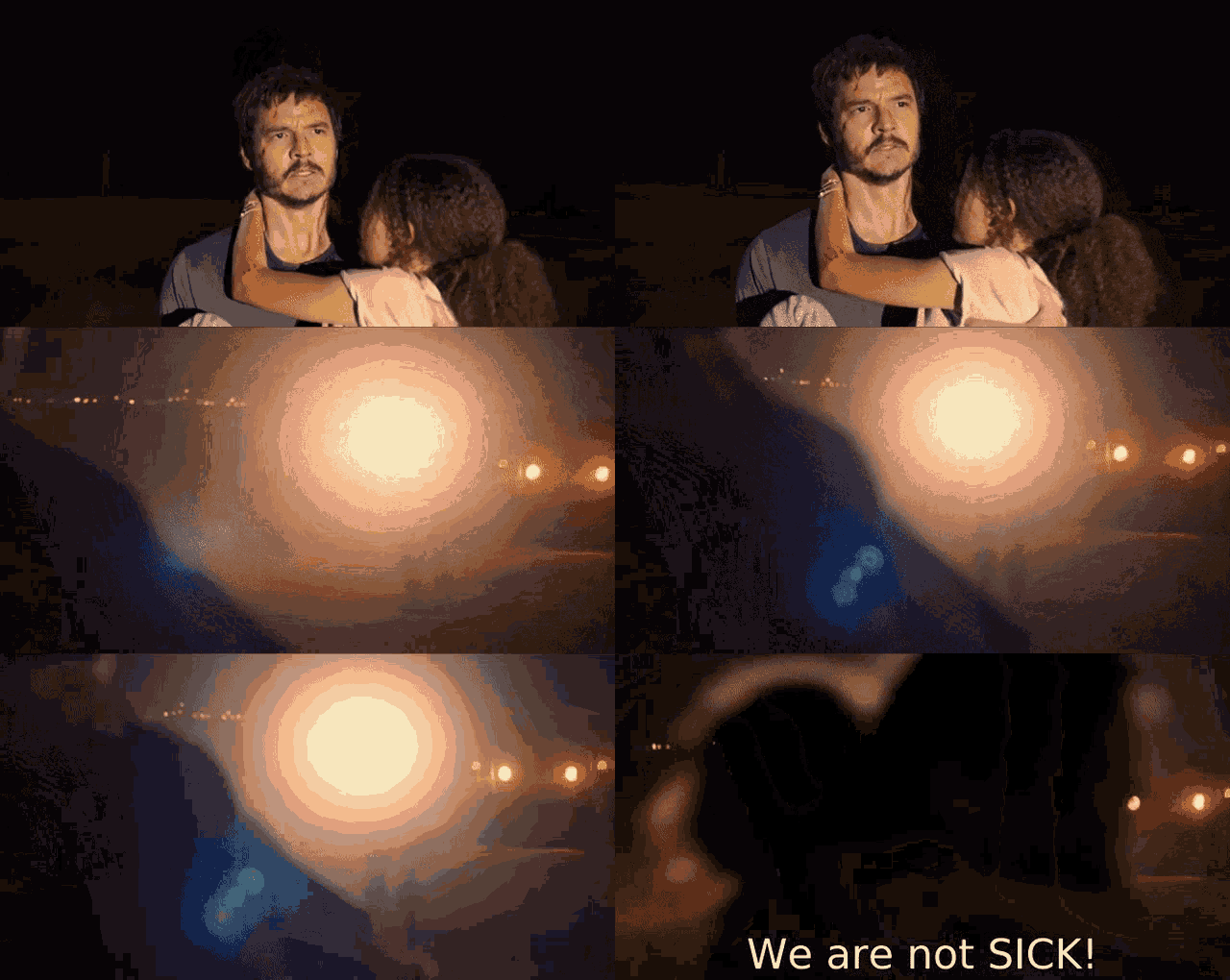
For the act two break, we jump ahead twenty years to post apocalyptic Boston (as played largely by The Volume I talked about earlier) and our first image isn’t Joel (but he’s coming) it’s… a lost young girl coming out of the wilderness. She’s put in quarantine but offered safety with the post apocalypse fascists.
We catch up with Joel as he works with a crew to dispose of dead bodies into a communal pyre. His co-worker (I guess, we never see this person again) reaches out… there’s a child’s body, she can’t bring herself to burn it. But he sure can, because he’s so broken! If only a surrogate needing his paternal protection were to come along, say one who’s also a macguffin that could save all of humanity, why you’d have a premise for what some have called the greatest video game story of all time!
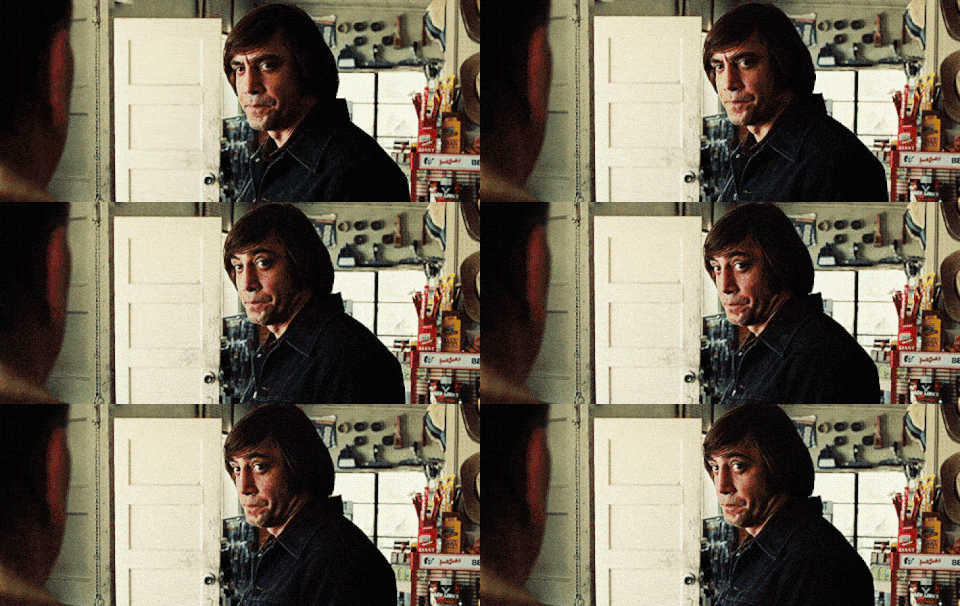
I haven’t played The Last of Us: The Game, but I felt I should shout it out, and the influence of Cormac Mccarthy’s The Road and No Country For Old Men on it, as outlined by Tim Rogers in his Action Button Dot Com review, and if a two hour exploration of the game and it’s origins sounds appealing, check it out on Youtube!
As I was saying, present day Joel is a stone cold hustler, unafraid to commit violence, and sell contraband, (but not smuggle people!) He’s also concerned about his brother Tommy who’s out west somewhere not sending any radio updates, and his partner Tess.
Speaking of Tess and the Coen Bros, rewatching the pilot I’m struck by the midpoint, a rather comic scene after all the dark shit we’ve just been through, and a very Coen bros esque note to introduce Tess on, as she negotiates with the local dummy criminals who ripped her off, but are “afraid of her guy”, we’ll soon learning meaning Joel, and understand how scary he’s become. Before a bomb blows all their shit up! Tension and release! Coen bros influence!
With Tess introduced (but before she’s tied back to Joel, interestingly) we meet Ellie. And set up the stakes of Joel’s concern for Tommy and the dangers of the outside world. Then because it’s an HBO show, ominous music plays as Joel DRINKS WHISKEY, because he’s a tormented male anti hero and in these kinds of stories, ANTI HEROES DRINK AND DREAM OF THEIR DEAD DAUGHTERS. I’m being facetious because it’s fun, but it’s a very solid series of story moves that writers can acknowledge and learn from.
In the next scene, I appreciate Tess’s comment about kids born after the outbreak, because they’ve got one coming down the pipeline who they’ll need to protect! But first they need to scheme about how to hurt this Robert dude who ripped off Tess, because like any good violence Dad, Pedro’s modus operandi is hurting people, ya see Meanwhile some exposition happens with our rebellious anti fascist firefly friends who are the ones holding on to Elle for reasons yet to be explained!
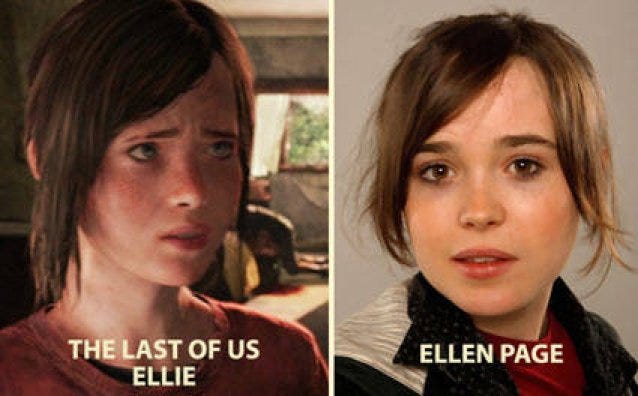
You know there’s a whole history of how the creators of The Last Of Us (the video game) pretty much ripped off another “serious story AAA budget” video game coming out around the same time, starring… Eliot Page, relatively fresh off their performance in Juno. So let’s just say Elle’s name starting with an E wasn’t a mistake. And I appreciate what Bella Ramsey brings to the role and how it interfaces with Pedro Pascal’s vibe. It’s good casting!
I’ve been describing the pilot of The Last of Us for a while and now I’m bored, so I’ll skip to the end when Joel’s trauma at the death of his daughter in the intro gives him the courage (and indeed, the violence/killer instinct) to save his crew from the soldier he’d sold drugs to earlier! That’s what I call bringing things full circle.
Maybe the last interesting observation I have about this show is how it sets itself apart from The Walking Dead, which I think is still the biggest TV show of this century. There is a certain… grim optimism to The Last Of Us but I never got from The Walking Dead, or other modern Zombie stories that come to mind like 28 Days Later.
Jason Paragin on Tiktok pointed out that unlike The Walking Dead, which created this wild west fantasy where the strong survive by blowing off zombie heads, that even in the dystopian post apocalypse, society will continue and you will still have to work a shitty job! A notion… I actually find oddly comforting in this paternalistic wrapping of found families, with Pedro Pascal as your post apocalyptic murder daddy who learns to love you as the daughter he lost.
That being said, I think on the whole I prefer Boba Fett and Baby Yoda. I mean the Mandalorian. But actually if you take anything from this piece, it’s to go watch Lone Wolf and Cub: Sword of Vengeance on HBO Max, that shit is the best!
And tune in later this week for my thoughts on the finale of The Last of Us, and an examination of what themes they set up, and how do they tie them together?